

Are you paying too much per click in Google Ads? Chances are your Quality Score is the culprit. Many advertisers focus on bids and budget, while Google mainly cares about relevance. A low Quality Score leads to higher CPCs, worse ad positions, and less performance from the same budget.
The good news? You can improve your Quality Score without paying more. By aligning your ad copy, keyword structure, and landing pages more closely, you can lower costs and boost results.
In this article, you’ll learn step by step how to improve your Quality Score in Google Ads, practical, immediately actionable, and without complicated theory.

2. What determines your Quality Score?
Your Quality Score is determined by three factors.
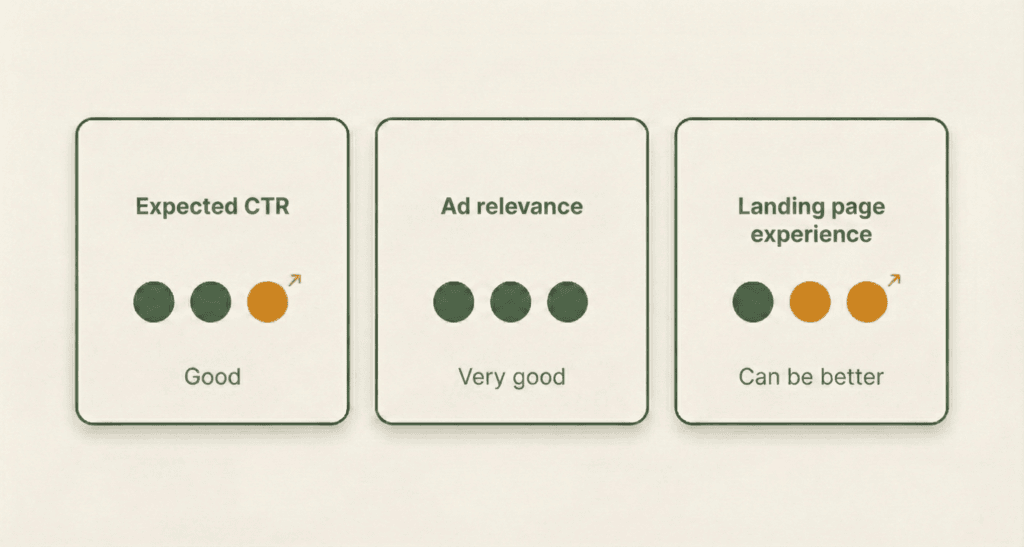
1. Expected CTR
This is the likelihood that someone will click on your ad. Google looks at historical data and how appealing your ad is. If your CTR is low, Google assumes your ad is not relevant enough. This is often the biggest issue, because many ads are too generic.
2. Ad Relevance
Your keyword should clearly appear in your ad. The better the match between the search term and your ad copy, the higher your score.
3. Landing Page Experience
Your page must be relevant, fast, and easy to use, especially on mobile.

3. What do the Quality Score ratings (1–10) mean?
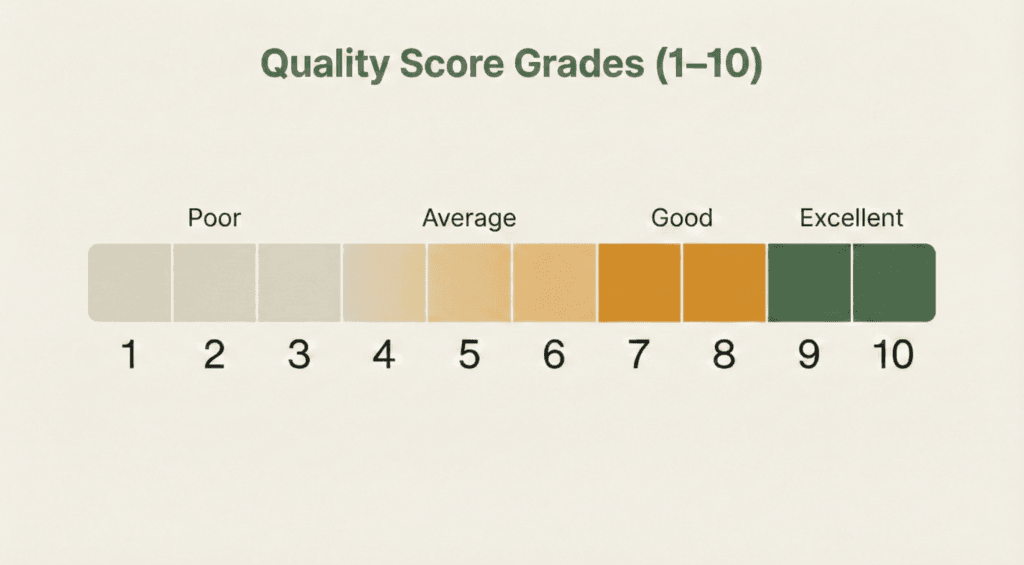
Each keyword in Google Ads receives a Quality Score from 1 to 10. This number shows how relevant Google considers your ad to be.
A score of 1 to 3 is poor. Your ad does not match well, and you will often pay more per click.
A score of 4 to 6 is average. There is clear room for improvement.
A score of 7 to 8 is good. Your ads are relevant and efficient.
A score of 9 to 10 is excellent. These are the keywords you can confidently scale.
4. Step 1: Improve your expected CTR
Want to increase your Quality Score? Start with your expected CTR.
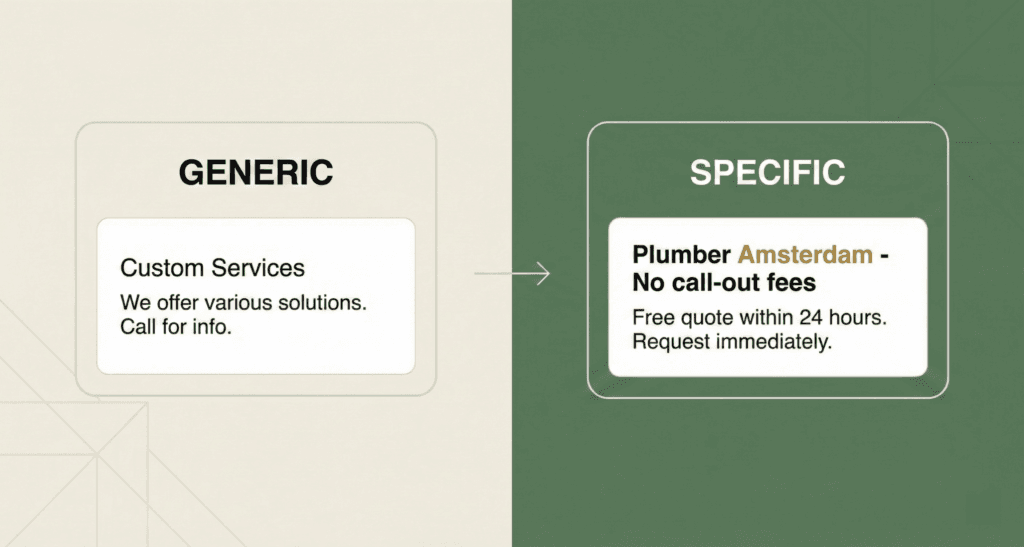
Write more specific ads. Include your main keyword in the headlines. Highlight clear benefits, such as “Free quote within 24 hours” or “No call-out fees.” End with a strong CTA like “Request a quote today.”
Use strong USPs. Think about price, speed, guarantee, or your location. This makes your ad more appealing.
Test multiple variations. Use Responsive Search Ads and vary your headlines and descriptions.
Add extensions. Use sitelinks, callouts, and structured snippets to show more information and take up more space.
5. Step 2: Increase ad relevance
Ad relevance is about the match between your keyword and your ad. The stronger the match, the higher your Quality Score.
Split your ad groups into smaller segments. Don’t put 20 different keywords into one group. Create tightly focused groups so you can write more targeted ads.
Match your keyword exactly with your ad copy. If someone searches for “roofing contractor Amsterdam”, include that phrase in your headline.
Avoid overly broad keywords without control. Broad terms often attract irrelevant clicks. Use clear match types and add negative keywords to keep your traffic focused.
6. Step 3: Optimize your landing page
Your ad may be strong, but without a solid landing page, your Quality Score will still drop.
Make sure there is a 1-to-1 match with the search intent. If someone searches for “Google Ads specialist Rotterdam”, that phrase should immediately appear on your page.
Place your main keyword above the fold. Visitors should instantly see they are in the right place.
Improve your loading speed, especially on mobile. A slow page costs clicks and conversions.
Make conversion easy. Use a short form, a clear CTA, and add trust elements like reviews or certifications to increase both conversion rate and relevance.

7. Common mistakes that keep your Quality Score low
Many advertisers make the same mistakes, which keeps their Quality Score low.
An overly broad campaign structure is a major issue. If you put everything into one campaign, your ads become less relevant.
A poor keyword match also leads to low scores. If you use a general keyword but show a very specific ad, the message does not align.
Generic ads without clear benefits attract fewer clicks.
The wrong landing page hurts user experience.
And without negative keywords, you attract irrelevant traffic. That lowers your CTR and, in turn, your Quality Score. Focus on structure and relevance.
8. How do you check if your improvements are working?
You want to know if your changes are actually working. Start by adding the Quality Score columns in Google Ads. This allows you to see how your score changes per keyword.
Then review performance at the component level. Check expected CTR, ad relevance, and landing page experience. This shows where improvements are happening.
Also monitor your CPC. If your cost per click decreases, you’re moving in the right direction.
Finally, track your impression share. If it increases without raising your budget, Google is rewarding your improvements with more visibility. Review this weekly for clear insights.
9. How to view Quality Score in Google Ads
You can find the Quality Score at the keyword level.
In Google Ads, go to Keywords. Then click on Modify columns. Add the columns for Quality Score, expected CTR, ad relevance, and landing page experience.
This allows you to see where the issue lies for each keyword.
Check this regularly. If you see many scores of 5 or lower, you need to optimize. Scores of 7 or higher are generally healthy.
10. What does a higher Quality Score actually deliver?
A higher Quality Score delivers immediate benefits. The first effect is a lower CPC. You pay less per click because Google considers your ad more relevant.
You also gain a better ad position. You can rank above competitors, even if they bid more.
In addition, you get more clicks for the same budget. Lower costs mean more traffic without increasing spend.
Finally, a high Quality Score improves scalability. You can expand your campaigns without your costs rising sharply. This makes your Google Ads account more efficient and profitable in the long term.
11. Summary & key insights
Quality Score is not a goal in itself. It’s a signal from Google that shows how relevant and efficient your campaigns are. Think of it as a benchmark, not the end goal.
The real focus should be on relevance and user experience. Do your keywords, ads, and landing pages align clearly? If they do, a higher Quality Score will follow naturally.
Often, small structural improvements make a big difference. Think tighter ad groups, sharper ad copy, or a faster landing page. By working on these consistently, you lower costs and improve results over the long term.
Ready to truly improve your Quality Score?
Don’t get stuck making small tweaks without a clear strategy. At Search Summit, we help businesses structure their Google Ads accounts smarter, lower cost per click, and get more results from the same budget.
Want to know where your Quality Score is costing you money?
Schedule a short, no-obligation Google Ads check and discover where the biggest optimization opportunities are.



